
Project overview
Faithy is an AI-powered faith companion offering personalized devotionals and prayer tools. In a deeply personal space like spirituality, language becomes the interface.
I was brought in to redesign the onboarding experience, transforming AI-generated, high-friction copy into a clear, human-centered flow that builds trust and drives engagement.
Goals
The primary objective was to convert first-time users into daily active participants. Before my involvement, the onboarding flow relied on raw AI output that felt impersonal and technically dense. My goals were to:
Humanize the interface: Bridge the gap between technology and spirituality.
Build trust: Clearly explain AI capabilities while maintaining ethical boundaries.
Establish a system: Create a Content Style Guide to ensure long-term consistency across AI-generated prompts.
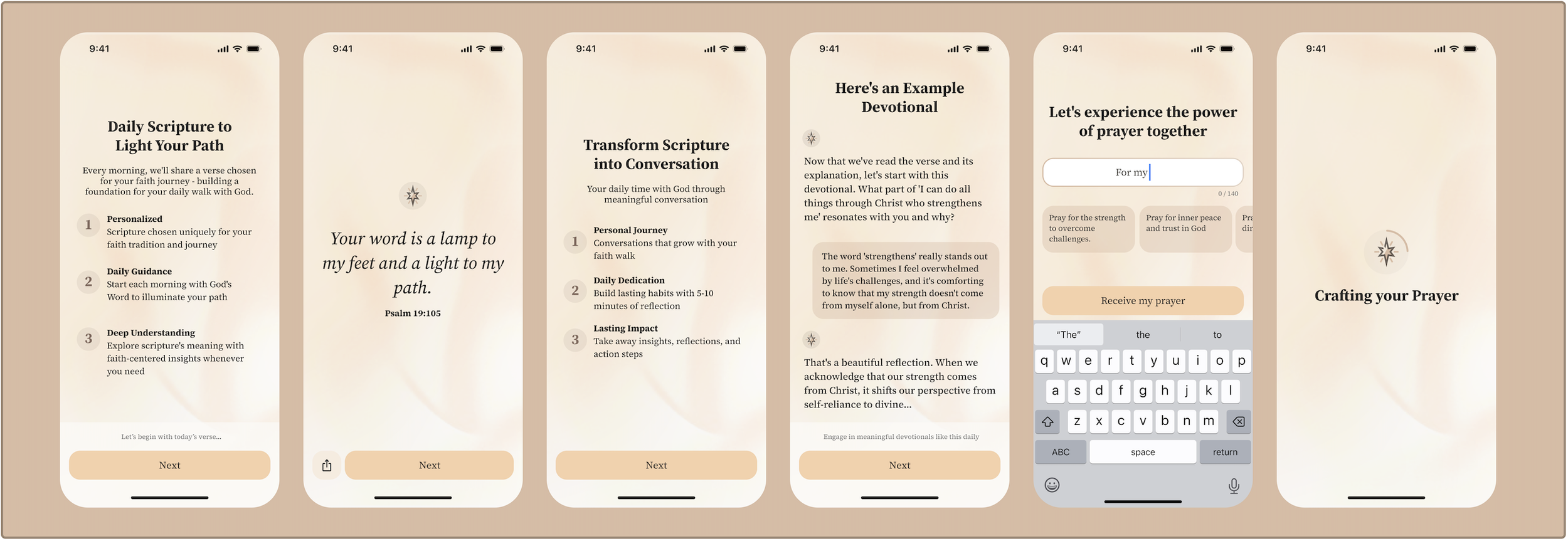
Faithy: Old UX copy
My process
User research & personas: Conducted research to understand user motivations, leading to the creation of two proto-personas to represent distinct demographics. This ensured the tone resonated with both daily seekers and new believers.
Linguistic audience: Identified wordy, theological phrasing and abstract metaphors that could be replaced with more direct, action-oriented language.
Competitive analysis: Audited market leaders like Glorify to identify successful patterns in spiritual UX and mental models.
Iterative drafting: Used a "human-in-the-loop" workflow — leveraging AI for high-volume brainstorming, then applying editorial rigor to ensure emotional resonance and brevity.
Style guide creation: Documented voice, tone, and ethical guidelines for all future AI content to ensure scalability.
Challenge
The original AI-generated copy suffered from high cognitive load. Sentences were overly long and indirect, often requiring users to read screens twice to understand the app's actual functionality. I had to design a narrative that presented AI as a facilitator, not a replacement for spiritual community, while removing the flowery friction that slowed down the sign-up momentum.
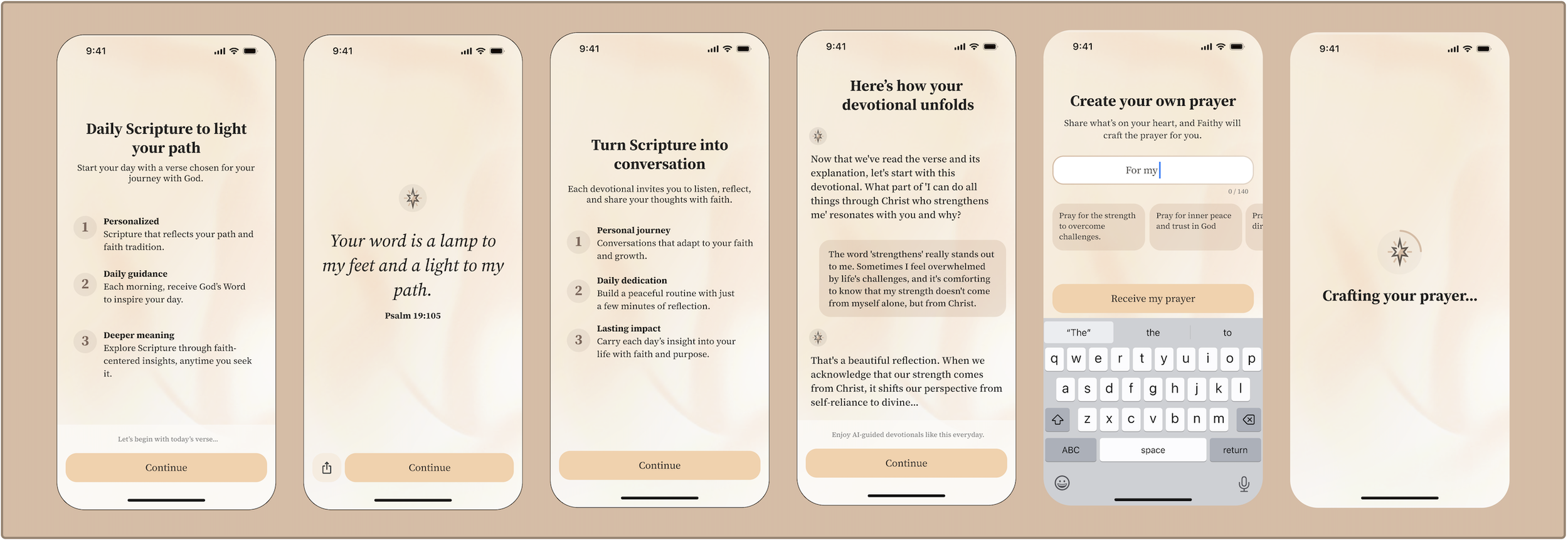
Faithy: New UX copy
Results
By replacing high-friction prose with direct, benefit-driven microcopy, the redesigned onboarding flow saw a significant lift in user retention and engagement:
+24% increase in onboarding completion rate.
10% reduction in user drop-off during the initial setup.
Strategic impact
Beyond the metrics, the intervention achieved a much higher level of product transparency:
Clarified AI features: I redefined the AI’s role from a vague intermediary to a functional facilitator. For example, I shifted the prayer headline from the passive "Let’s experience the power of prayer together" to the active "Create your own prayer," empowering the user to lead the experience.
Eliminated double-reading: Streamlined the narrative flow, allowing users to move through onboarding with zero stop-and-start confusion.
Immediate value discovery: The value proposition of the Scripture, Devotional, and Prayer features became instantly clear, leading to higher immediate engagement post-onboarding.
Operational scale: The new Content Style Guide empowered the engineering team to deploy consistent, on-brand AI prompts without constant manual oversight.
Next steps
A/B testing: Refining CTA copy to further optimize the conversion from onboarding to "first prayer" generation.
Contextual personalization: Researching how the AI's tone of voice could automatically shift based on the user's emotional state (e.g., supportive for comfort vs. motivational for discipline).
Ethical transparency: Continually refining how we signal AI-generated content to ensure users always feel informed and in control of their spiritual experience.